SEO helps your portfolio rank in search results, AEO helps it become the answer to a question, and GEO helps AI tools like ChatGPT and Google's AI Overviews understand and cite it. For an artist or photographer, they're one job, not three: Google itself says optimizing for AI search is still SEO. Clear words about who you are and what each project is do most of the work.
If you've read anything about websites this year, you've met two new acronyms. They come with a lot of advice, much of it written for online shops and software companies. This guide explains what each means for a portfolio, and which parts are worth your time. We had to answer these questions for ourselves when we built the search side of Index, our portfolio theme for Ghost. This is the plain version.
What do SEO, AEO, and GEO mean?
- SEO (search engine optimization): helping search engines find, understand, and rank your pages. The goal is a place in the list of results.
- AEO (answer engine optimization): helping your page become the answer when someone asks a question, in a search result or in an AI reply.
- GEO (generative engine optimization): helping AI tools that write answers, like ChatGPT, Perplexity, Claude, and Google's AI Overviews and AI Mode, understand your site well enough to mention it and link to it.
The three overlap almost entirely. Google says it directly in its guide for site owners: optimizing for its AI features is still SEO. The same pages, written the same way, serve all three.
| SEO | AEO | GEO | |
|---|---|---|---|
| Short for | Search engine optimization | Answer engine optimization | Generative engine optimization |
| Where you show up | The list of search results | A direct answer: a snippet, a voice reply, an AI answer | Inside an answer written by an AI tool, as a mention or a linked source |
| What it rewards | Clear, useful pages that match a search | A plain, quotable answer to one question | Clear facts that a tool can trust and repeat |
| What a portfolio needs | Your name, what you make, and where, in titles and text | A first sentence on each page that answers who or what | The same, plus being described the same way on other sites |
The name GEO comes from a 2023 research paper by researchers at Princeton and elsewhere, presented at the KDD conference in 2024, which tested how changes to a page affect whether AI answers cite it. AEO is older, from the days of voice assistants and featured snippets. Both describe goals, not new techniques.
How do people find portfolios now?
A gallery assistant used to type "street photographer Copenhagen" into Google and scroll. Today the same person might ask ChatGPT for "documentary photographers in Copenhagen who shoot at night" and get a short written answer with a few names and links. Or they see an AI Overview at the top of Google before any ordinary results.
Those answers are built from pages the AI tool can reach and read. Each service has its own way of searching: ChatGPT search uses OpenAI's search crawler, Perplexity builds its own index, and Google's AI answers come from Google Search. Your site can be one of the sources, but nobody can promise it will be, and the answers change from day to day.
What actually helps an artist or photographer?
- Let the tools in. Your pages need to be public and indexed. Most Ghost sites already are. If you'd like to keep AI training crawlers out while letting AI search in, see Ghost robots.txt for AI crawlers.
- Say plainly who you are. Your name, what you make, and where you're based, in your site title, site description, and the first lines of your about page. "Documentary photographer in Copenhagen" matches far more questions than "visual storyteller".
- Describe every project in words. An AI tool can't look at your photos the way a person does. A one-line description, a year, a place, and alt text give it something to work with. Our portfolio project description examples show how.
- Show first-hand work. Google's guidance favors content that isn't a restatement of what's already online. A portfolio, and a journal about how you made it, is about as first-hand as it gets.
- Be mentioned elsewhere. Interviews, features, exhibition pages, and directory listings that link to you are what make an AI tool confident enough to name you. More in How to show up in ChatGPT.
The same portfolio, before and after
Here's what the advice above looks like on a real page. The photographer is invented.
| Before | After | |
|---|---|---|
| Site title | MIKKEL | VISUALS | Mikkel Holm, documentary photographer in Copenhagen |
| About page, first line | Capturing moments that matter. | I'm a documentary photographer in Copenhagen, working on long projects about night work and public transport. |
| A project's first sentence | A journey into the dark. | Night Line is a series of portraits of people on Copenhagen's night buses, made between 2023 and 2025. |
| An image's alt text | IMG_4471 | A woman reads on a night bus, lit by the overhead lights. |
Nothing in the after column is a trick. It's what a person would want to know, written down. That's also what search engines and AI tools can read, match to a question, and repeat.
What this looks like for different kinds of work
- Photographers: say what you photograph and where ("wedding photographer in the Lake District"), and caption series with place and year.
- Illustrators: name your subjects and clients ("botanical illustration for books and packaging"), since "illustrator" alone matches millions of people.
- Designers: write each case study's first line as the problem and the result, and name the kind of design (identity, wayfinding, product).
- Painters and sculptors: name your medium and your themes, and keep an up-to-date list of exhibitions, which is the proof galleries and AI tools both look for.
- Students and job seekers: say what you're looking for and where, in your about page's first lines, so a search for your name answers the question a recruiter or admissions reader has.
SEO, AEO, and GEO side by side
| SEO | AEO | GEO | |
|---|---|---|---|
| The goal | Rank in search results | Be the direct answer to a question | Be named or cited in an AI-written answer |
| Where it shows | Google's and Bing's results | Featured snippets, People also ask, voice answers | ChatGPT, Perplexity, Google's AI answers |
| How you'd measure it | Rankings and clicks | Whether your page is the quoted answer | Whether you're named or linked when you ask |
| What helps most | Clear pages, good titles, links from other sites | A short, direct answer near the top of the page | Consistent facts about you across many sites |
The last row is why the three overlap so much for an artist or photographer: a clear site, plainly described work, and mentions elsewhere help all three at once.
What can you safely ignore?
- Rewriting everything "for AI". Google says there's no need to chop your writing into tiny pieces or chase every variation of a phrase. Write for a person.
- Special AI files and markup as a ranking trick. Google says its AI features don't use llms.txt or special "AI" markup. Ghost can make an llms.txt file for you and other tools may read it, but it isn't a lever you need to pull. (More in Ghost llms.txt.)
- Tools that promise a citation. Google points out that no outside tool can see inside its ranking or AI systems, and the same goes for other AI tools. Trackers can be useful for watching trends, not for guarantees.
- Publishing dozens of near-identical pages. Making lots of pages to sway rankings or AI answers can count as spam under Google's policies, and it makes a portfolio worse for the people who matter.
How Index helps
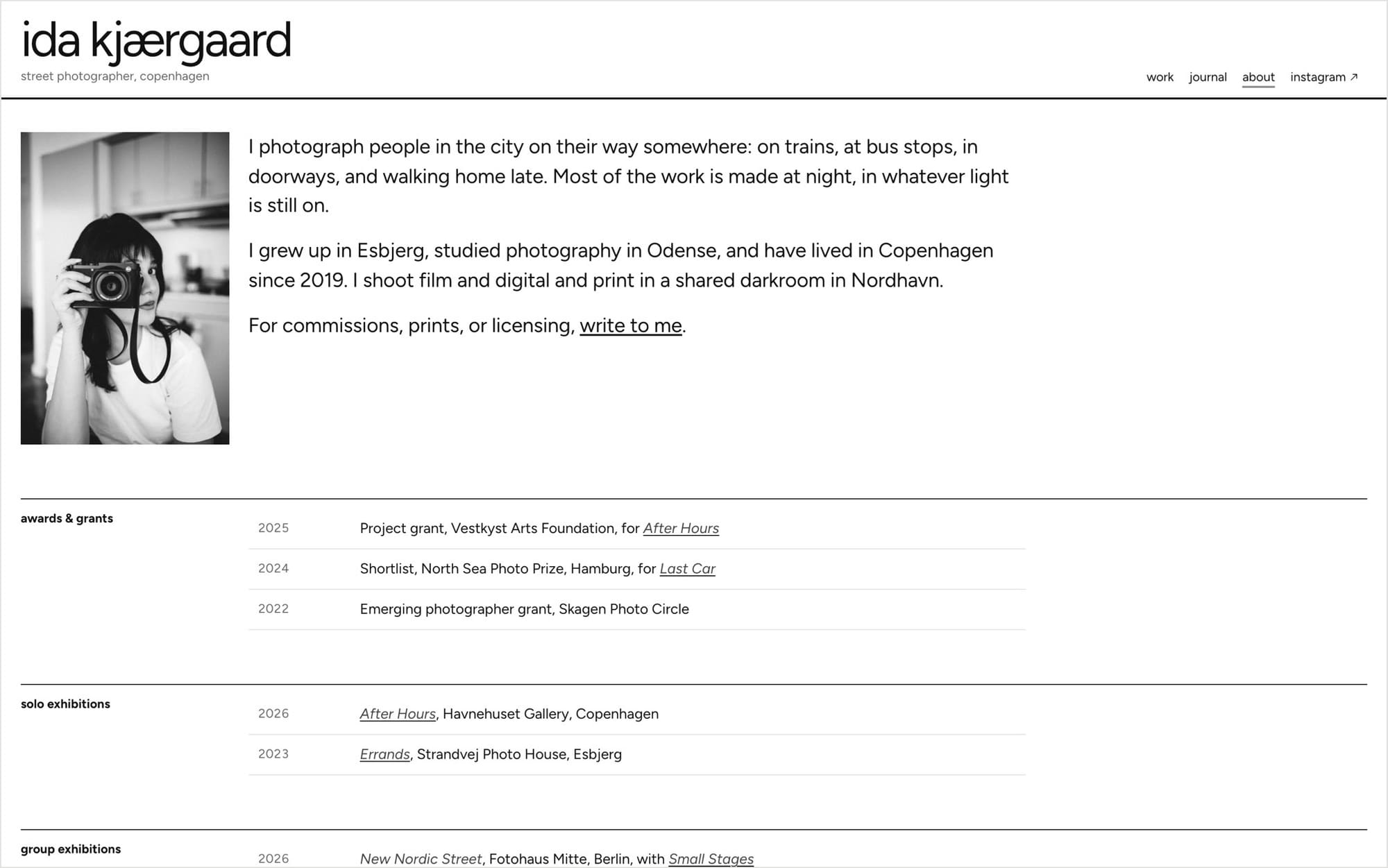
We built Index, our portfolio theme for Ghost, so the groundwork above is mostly done for you. Ghost describes every page in general terms: a website, an article. Index adds a description made for a portfolio, in the structured data that search engines and AI tools read:
- You, as a person or a studio, with your name, description, portrait, and links to your other profiles.
- Each project as a creative work, with its description, cover image, year, and place, made by you, rather than as "an article".
- Your homepage as the list of your projects, and your about page as a profile of you.
It's also light: under 30 KB of CSS and JavaScript, compressed, with photos served as WebP at the right size for each screen. None of this can promise a place in an AI answer, but it means that when these tools look at your site, they can tell who made the work and what each project is. The details are in our docs: structured data for search and AI.
A five-minute check
Open your homepage and your best project, and ask:
- Does the site title say the name you work under?
- Does the first sentence of the project say what it is, where, and when?
- Does each image have alt text?
- Does your about page say what you make and where you're based in its first two lines?
Four yeses and you've covered what matters most. To see where you stand today, follow How to check your AI visibility for free. For the full setup on a Ghost site, start with Ghost CMS SEO for portfolios.
If you'd rather not think about the structured data at all, that's the part we built into Index: it describes you and every project from what you've already written, and keeps out of the way so the work is what people see.
Guides in this series
- How to show up in ChatGPT and other AI answers
- How to check your AI visibility for free
- How to Google yourself as an artist
- Ghost CMS SEO for portfolios
- Ghost llms.txt
- Ghost robots.txt for AI crawlers
Questions people ask
What is the difference between AEO, GEO, and SEO?
SEO helps your pages rank in search results. AEO helps them become the direct answer to a question. GEO helps AI tools that write answers, like ChatGPT and Google's AI Overviews, understand and cite your site. They overlap heavily, and the same groundwork serves all three.
Is GEO different from SEO?
Mostly not. Google says optimizing for its AI features is still SEO: crawlable pages, clear writing, first-hand work, and other sites linking to you help in both.
Do artists and photographers need AEO or GEO?
Not as a separate project. A clear site title, a plain first sentence on each project, an about page that says who you are and where you work, and alt text on your images cover what matters.
Does llms.txt help with AI search?
Not with Google: it says its AI features don't use llms.txt. Some other AI tools may read it, so it's a small bonus rather than something to rely on.
Index is our portfolio theme for Ghost. It builds your structured data from what you've already written, so the groundwork for search and AI answers is in place as you add projects. Take the tour or try the live demo.
Where does the term GEO come from?
From a 2023 research paper, "GEO: Generative Engine Optimization," by researchers at Princeton and elsewhere, presented at KDD in 2024. It studied how changes to a page affect whether AI answers cite it.
What is an example of AEO?
Writing the first line of your about page as a direct answer, such as "I'm a documentary photographer in Copenhagen," so a search or an AI tool asked "who is this photographer?" can quote it.
Is AEO better than SEO?
Neither is better, because they're the same work aimed at different places: SEO for search results, AEO for direct answers. A clear page that answers questions plainly does well at both.
Is SEO being replaced by AEO?
No. AI answers are built from pages that search engines can find and trust, so good SEO is still the foundation. Google says optimizing for its AI features is still SEO.
Written by Pacha Themes. A small design studio making spacious, minimal themes for Ghost. Our first, Index, is a portfolio theme with 24 layouts, built and tested on Ghost 6. We write about Ghost, web design, and tips for creators here.