An artist bio is a short introduction to who you are, what you make, and where you work. Most artists need two versions: a short bio of 40 to 60 words in the third person, for press and profiles, and a longer one of 150 to 300 words for the about page on your website. The best ones open with your work and your place, add a little proof, and end with something human.
Below are 14 artist bio examples, short, medium, and long, for photographers, painters, illustrators, designers, self-taught artists, students, and artists with no shows yet. Then a simple formula, fixes for the most common mistakes, and how to set it all out on an about page.
Something we noticed while making the five about page layouts in our theme, Index: one sample bio had to work in all of them, and the first sentence always did most of the work. It's the one people, and search engines, actually read.
For the rest of the site, see our step-by-step guide to a portfolio website for photographers, which works for any artist.
A simple formula for any artist bio
Most good bios follow the same four steps. Write one or two sentences for each.
- What you make, and where. The kind of work, and where you're based.
- What makes it yours. The subjects, places, materials, or questions your work keeps coming back to.
- Proof. A few exhibitions, publications, clients, or awards, the strongest first.
- A human detail. Something true and specific about how you work, or what you're working on next.
Or use this artist bio template and fill in the blanks: "I'm [name], a [kind of artist] based in [place]. I make [what], about [subject]. My work has [proof]. [A human detail]. [How to reach you]." Then cut every word that doesn't earn its place.
Artist bio examples
Every example here is invented. The names, places, and credits are made up, so borrow the structure, not the details. Each one follows the formula above.
Brief and short artist bio examples (40 to 60 words)
These brief bio examples work well for social profiles, press releases, show listings, and the line under your name in a magazine. Use the third person for anything you send out, since editors often paste it in as it is. On your own profiles, first person is fine.
1. A documentary photographer, third person:
Ana Ruiz is a documentary photographer based in Lisbon. Her long-term work follows rivers in southern Europe and the towns around them. She has been published in The Guardian and Le Monde.
2. A painter, third person:
Maya Okafor is a painter based in Leeds. She makes large, layered oil paintings of city parks at the edges of the day, when they are almost empty. Her work has been shown in group exhibitions across the north of England, and she was shortlisted for a regional painting prize in 2025.
3. An illustrator, third person:
Tom Reyes is an illustrator in Austin, Texas. He draws maps, book covers, and editorial pieces with a fine pen and flat color. His clients include independent publishers, food magazines, and the city's parks department. He also teaches a monthly drawing class for beginners at his local library.
4. An emerging artist with no shows yet, third person:
Lena Fischer is a photographer in Hamburg, finishing her first long project about the night shift at the city's port. She works in black and white, on foot, and mostly after dark. She is looking for editorial commissions and her first group show.
No exhibitions? Lead with the work and what you want next, as Lena does. A clear subject is more convincing than a thin list of credits.
5. An architectural photographer, third person:
Daniel Moreau is an architectural photographer based in Lyon. He photographs new buildings, renovations, and interiors for architects and design magazines, in a calm, straight-on style that lets the building speak. He works across France and Switzerland.
6. A ceramic artist, first person, for Instagram or a shop:
I make everyday stoneware in a small studio in Asheville, North Carolina: mugs, bowls, and plates glazed in the colors of the river nearby. Everything is wheel thrown and fired in small batches. New pieces go to my newsletter first.
7. A self-taught artist bio sample, third person:
Ruth Abara is a self-taught painter in Lagos who began painting in 2019, after twenty years as a nurse. She paints the markets and hospital corridors she knows best, in bright acrylic on board. Her first solo exhibition opened at a community gallery in 2025.
Self-taught? Say so plainly, then let the subject and the work do the rest.
8. An art student, first person:
I'm a second-year fine art student in Glasgow, working mostly in printmaking. My current prints look at the tower blocks I grew up in, layered from old architectural plans. I'm looking for my first group show and a summer residency.
Longer artist bio examples (100 to 150 words)
These suit the top of an about page. First person usually reads warmer on your own site.
9. A documentary photographer, first person:
I'm a documentary photographer based in Lisbon. For the last eight years I've followed rivers across southern Europe, and the towns that grow and empty around them. My work has appeared in The Guardian and Le Monde, and was shown at Encontros da Imagem in 2025. I shoot on film when I can, and I'm currently working on a book about the Tagus.
10. A graphic designer, first person:
I'm an independent graphic designer in Toronto, working on identities, books, and signage for cultural organizations. I like projects where type does most of the talking. Recent clients include two museums, a public library, and a dance festival. Before going independent, I spent five years at a branding studio.
11. A wedding photographer, first person:
I'm Sara Lind, a wedding and elopement photographer based in Bergen, Norway. I photograph small weddings, mostly outdoors, for couples who would rather take a long walk in the mountains than stand through a long list of posed photos. My style is documentary. I follow the day as it happens and step in only when the light asks for it. I've photographed weddings across Norway and Iceland for eight seasons, and I take on about 20 a year, so each couple gets my full attention. If you're planning something small and outdoors, write to me with your date and place.
12. A textile artist, third person:
Priya Nair is a textile artist based in Melbourne. She weaves large wall pieces from recycled wool and cotton, using patterns from the saris and blankets she grew up with. Her work asks what we keep from the places we leave. Nair has had solo exhibitions in Melbourne and Sydney, and has shown in group exhibitions in Singapore and Auckland. In 2024 she spent three months in residence at a weaving mill in Gujarat, which led to her current series, Warp. She teaches weaving workshops twice a year.
13. A designer just out of school, first person:
I'm a graphic designer and a recent graduate of a design degree in Glasgow, where I focused on type and wayfinding. My final project was a signage system for a city hospital, tested with patients and staff over two months. I like work that has to be useful before it can be beautiful. I'm looking for a junior role, or freelance work with studios that design for public spaces. You'll find the hospital project and three others below.
A long artist bio example (about 250 words)
A long bio belongs on an about page where people have chosen to read more, or in a grant or residency application. Keep the same order: work, place, approach, proof, and a human close.
14. A painter, first person:
I'm Jonah Weiss, a painter living and working in Santa Fe, New Mexico. For twelve years I've painted the high desert. I don't think of myself as a landscape painter so much as someone trying to paint weather: the hour before a storm, dust moving across a road, light that changes faster than I can mix it.
I work in oil on linen, mostly at a large scale. Every painting starts outside with small studies and is finished in the studio. Each series takes about two years. My current one, Monsoon, follows a single summer of storms across the Galisteo Basin.
My paintings have been shown in solo exhibitions in Santa Fe, Denver, and Tucson, and in group shows in Los Angeles and New York. I've received two state arts council fellowships, and my work is held in a university museum and in private collections across the United States.
Before I painted full time, I spent ten years painting sets for the theater. That's where I learned to work fast, work big, and step back often.
I take on a few commissions each year, and new work goes to my newsletter before it goes to galleries. If you'd like to visit the studio, write to me. I'm happy to show you what's on the wall.
Before and after: three quick fixes
Most weak bios have the same few problems. Here's what each looks like, and a rewrite.
Too general. Before: "I've been passionate about art since I was a child, and I believe creativity can change the world." After: "I paint small oil studies of kitchens, and the people who cook in them, from my studio in Porto." The rewrite names a subject, a medium, and a place.
All adjectives, no facts. Before: "Award-winning, internationally exhibited multidisciplinary artist exploring the human condition." After: "I make sculpture and video about how families share small apartments. My work has been shown in Berlin, Seoul, and Mexico City." Proof works better when it's specific.
Switching person. Before: "Ana is a photographer based in Lisbon. I started shooting rivers in 2017." After: "Ana Ruiz is a photographer based in Lisbon. She started photographing rivers in 2017." Pick first or third person and keep it to the end.
What goes on an about page
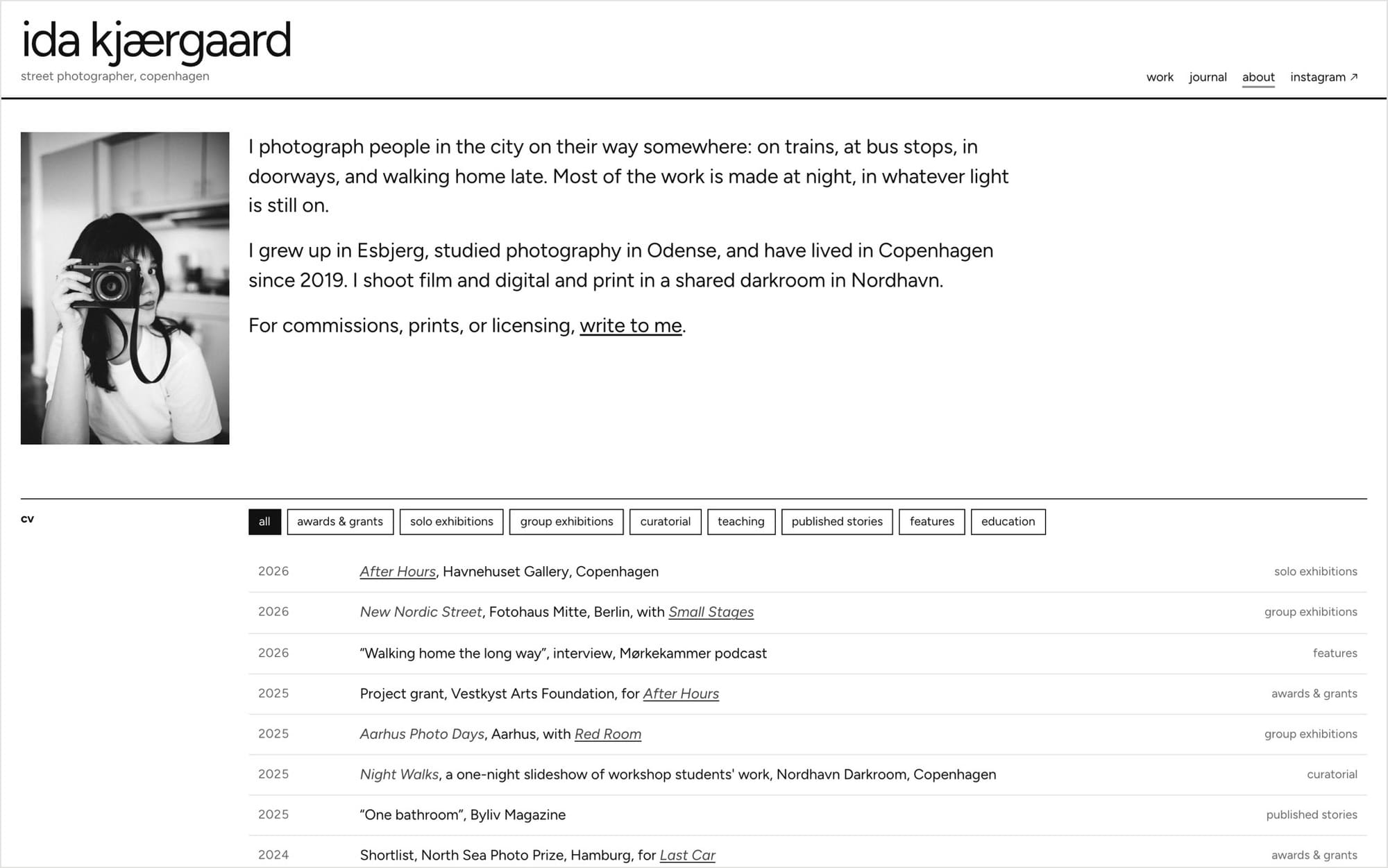
Your about page is often the second page people open, right after your best project. Editors, galleries, clients, and curators go there to decide whether to get in touch, so it pays to get it right. The good news is that a strong about page is short and simple. Here's what to put on it.
- A bio. Who you are and what you make, in a few short paragraphs.
- A photo of you. Recent, well lit, and looking like you do now. It doesn't need to be formal.
- What you take on. Commissions, editorial work, prints, teaching, or collaborations, so people know what to ask for.
- A short CV. Exhibitions, awards, publications, residencies, and selected clients, newest first.
- How to reach you. An email address or a contact form, and where you're based.
That's it. You don't need your life story, a list of every camera you own, or a mission statement.
How long should your bio be?
Write two versions and keep them in one document, like the examples above.
- A short bio, 40 to 60 words. For social profiles, press releases, festival programs, and the line under your name in a magazine.
- A longer bio, 150 to 300 words. For your about page, where people have chosen to read more.
If your about page bio runs much longer than 300 words, it usually means you're explaining your work rather than introducing yourself. That explanation belongs in an artist statement, or in the description of each project.
One bio, adjusted for each use
You don't need a new bio for every application. Keep one good version, then trim it or lead with something different for each use:
| Where it goes | Length | Person | Lead with |
|---|---|---|---|
| Instagram or another profile | One or two lines (Instagram allows 150 characters) | First | What you make, and where |
| Press release or show listing | 40 to 60 words | Third | Your name, your medium, and the show |
| Open call or gallery submission | 50 to 100 words, or their limit | Third | The work you're submitting, then two or three recent shows |
| Grant or residency application | 100 to 150 words, or their limit | Third | The project the money or time is for, then what you've done that shows you'll finish it |
| Your about page | 100 to 250 words | First | What you make and why, in your own voice |
Always follow the word limit an application gives you, even if it's shorter than these. Then update your bio every six months, and after any show, award, or publication, so the newest thing comes first.
First person or third person?
On your own website, first person usually feels warmer and more honest: "I photograph rivers and the people who live along them." It sounds like a person, which is what visitors want to meet.
Write your short bio in the third person, though. Galleries, editors, and festivals often print it exactly as you send it, and "Ana Ruiz photographs rivers" reads correctly anywhere. Whichever you choose for a version, stick to it from start to finish.
Bio or artist statement?
They're easy to mix up. A bio is about you: who you are, where you work, and what you've done. An artist statement is about the work: what it explores, and why. Your about page needs the bio. A statement works best next to the work itself, so many artists write a short one at the top of each project.
Your CV
A short CV helps people judge your experience at a glance. Group entries under headings, newest first, and give each entry a year:
- Exhibitions, solo and group
- Awards and grants
- Publications and press
- Residencies
- Selected clients
- Education, if it's relevant to your work
Leave out anything that doesn't help someone decide to work with you. Five strong entries beat twenty weak ones.
Common mistakes
- Opening with your childhood. "I've loved art since I was five" is true for nearly everyone. Start with what you make now.
- Vague words. "Passionate," "creative," and "unique" don't tell anyone anything. Specific subjects, places, and names do.
- No way to get in touch. Put your email address or contact form on the about page itself, not only in the footer.
- An old photo. If you'd be hard to recognize from it at an opening, replace it.
- Forgetting to update it. Put a reminder in your calendar every six months.
Laying it out on your site
Keep the page calm: your photo, your bio, then your CV, with plenty of space between them. On Ghost, your about page is a page rather than a post. If you use our theme, Index, you write your CV as simple lists under headings, starting each entry with a year, and the theme turns it into a tidy CV in one of five layouts. One of them, Ledger, lets visitors show just your exhibitions or just your awards with one click. The Index docs explain the about page and its CV layouts step by step.
Whatever you build it with, read your about page out loud before you publish it. If a sentence sounds like something you'd never say, rewrite it until it sounds like you.
Next, see how to make a portfolio website with Ghost, or how to start a newsletter for your creative work.
How search engines and AI read your about page
When someone asks Google or an AI tool "who is this photographer?", your about page is the page they look for. Help them: put your name, what you make, and where you're based in the first line, use the same short bio on every profile, and add a portrait. If you use Index, your about page is described to search engines as a profile of you, with its feature image as your portrait. More in How to Google yourself as an artist and How to show up in ChatGPT.
An about page that does this for you
We gave the about page five layouts of its own in Index, because it's the page that turns a visitor into a client, a gallery, an employer, or an admissions reader. You write your bio as plain paragraphs and your CV as simple lists starting with a year, and the theme sets it out in one of five layouts, from a quiet single column to a newspaper-style page. It also tells search engines the page is a profile of you, with your portrait.
Index has five about page layouts, each built around a bio and a CV like the ones above. Read through the tour, or open the demo's about page and switch between the five layouts.
Questions people ask
What is an artist bio?
A short introduction to who you are, what you make, and where you work, usually with a little proof such as exhibitions or clients. Most artists keep a short version of 40 to 60 words and a longer one of 150 to 300 words.
How long should an artist bio be?
Keep two versions. A short bio of 40 to 60 words for social profiles, press, and show listings, and a longer one of 150 to 300 words for your about page.
Should an artist bio be in first or third person?
Your about page usually reads best in the first person, because it sounds like you. Write the short bio in the third person, since editors, galleries, and festivals often print it as is.
What is the difference between an artist bio and an artist statement?
A bio is about you: who you are, where you work, and what you have done. A statement is about the work: what it explores and why. Your about page needs the bio, and many artists add a short statement to each project.
What should a photographer put on their about page?
A short bio, a recent photo of yourself, the kind of work you take on, selected clients or publications, exhibitions or awards if you have them, where you are based, and how to get in touch.
Should I put my CV on my portfolio website?
Yes, a short one. Exhibitions, awards, publications, residencies, and selected clients, newest first, help editors and galleries judge your experience quickly.
What is a good short artist bio?
Two or three sentences in the third person: what you make, where you're based, and one piece of proof, such as an exhibition, a publication, or a client. For example: "Maya Okafor is a painter based in Leeds. She paints city parks at the edges of the day. Her work has been shown across the north of England."
How do I write an artist bio with no experience?
Lead with the work instead of credits. Say what you make, where, and what it's about, then what you're looking for next, such as a first show or commissions. A clear subject is more convincing than a thin list of credits.
Written by Pacha Themes. A small design studio making spacious, minimal themes for Ghost. Our first, Index, is a portfolio theme with 24 layouts, built and tested on Ghost 6. We write about Ghost, web design, and tips for creators here.