Ghost is an open-source platform for building a website and sending email newsletters from the same place. It includes members, paid subscriptions, search, comments, and SEO, and it's run by the Ghost Foundation, a nonprofit. You can use it on Ghost(Pro), the official hosting, from $15 a month billed yearly, or run the free software on your own server. Writers, journalists, photographers, designers, and small studios use it to publish their work and reach readers directly.
If you've heard a writer say they "moved to Ghost," or you've seen "Powered by Ghost" at the bottom of a site you like, here's what it actually is, in plain language. We've built on Ghost since we started our studio: this site runs on it, and so does every theme we make.
Ghost at a glance
| Ghost | |
|---|---|
| What it is | An open-source platform for websites, blogs, and newsletters |
| Made by | The Ghost Foundation, a nonprofit |
| License | MIT: free to use, and free to host yourself |
| Hosting | Ghost(Pro), from $15 a month billed yearly ($29 to use your own theme), or your own server |
| Built in | Members, newsletters, paid subscriptions with no Ghost fee, search, comments, and analytics |
| Design | Themes, free and paid, changed in Ghost's design settings |
| Current version | Ghost 6 |
What Ghost does
- Your website. Pages, posts, and a design that comes from a theme you can change in settings.
- Newsletters. Visitors subscribe on your site, and you can email any post to them when you publish it.
- Members and paid subscriptions. Free sign-ups, paid tiers, and members-only posts, with payments through Stripe.
- The basics, built in. Search, comments, SEO, image resizing, and, since Ghost 6, analytics and a connection to the social web. Recent versions can also publish an llms.txt file for AI tools.
Most of what other platforms add with plugins or separate services comes with Ghost out of the box.
Who makes it
Ghost was started in 2013 by John O'Nolan and Hannah Wolfe as a simpler alternative to WordPress. It's run by the Ghost Foundation, a nonprofit, and its code is open source, so anyone can read it, run it, or build on it. Ghost(Pro), its paid hosting, funds the work. The code is released under the MIT license and has close to 56,000 stars on GitHub, a rough sign of how many developers follow it.
A short history of Ghost
Ghost started as an idea in a November 2012 blog post by John O'Nolan, a former deputy lead of WordPress's user interface team, who wanted a simpler platform made for publishing. In April 2013 he and Hannah Wolfe launched a Kickstarter campaign. It reached its goal in 11 hours and raised £196,362, and the first public version followed that autumn (Wikipedia, Ghost).
Since then, Ghost has grown from a blogging tool into a platform for websites, newsletters, and paid memberships, run by the non-profit Ghost Foundation. Ghost 6, in August 2025, added the social web and built-in analytics.
Is Ghost secure?
Ghost is open source, so its code is public. On Ghost(Pro), updates, backups, and security are handled for you; on a self-hosted site, keeping Ghost up to date is your job. Staff accounts can use two-factor sign-in and device verification, and a history log records who changed what. Members sign in with a link sent by email, so there are no member passwords to leak.
What it's like to use Ghost every day
We run this site on Ghost, including this blog and our studio's email list. Day to day, the parts we notice most are the editor, which stays out of the way, and having posts, members, and email in one place. We rarely think about the software itself.
The part that takes some learning is themes. Ghost has no plugins, so a feature it doesn't include comes from an integration or a little code, and the theme decides much of what your site can show. For a portfolio, we think that's a good trade: fewer moving parts, and a site that stays consistent.
How Ghost works, in five words
Ghost uses a handful of plain building blocks. Once you know them, the whole admin makes sense:
- Posts: anything dated, like journal entries, articles, or, with a portfolio theme, projects.
- Pages: things that don't change much, like your about page or contact page.
- Tags: how you group posts. Some themes use tags to decide what a post is. In our theme, a post tagged journal is a journal entry, and every other post is a project.
- Members: people who sign up on your site, free or paid. Your newsletter goes to them.
- Themes: the design. You change it through settings in Settings, then Design & branding, and swapping themes never touches your content.
What's new in Ghost 6
Ghost 6.0 arrived on August 4, 2025. It connected Ghost sites to the social web through an open standard called ActivityPub, so people on Bluesky, Threads, Mastodon, Flipboard, and other Ghost sites can follow and reply to your posts, and it added built-in analytics for web traffic and newsletters. Ghost ships small updates often, more than a hundred since Ghost 6 arrived.
What it costs
You can use Ghost two ways:
- Ghost(Pro), the official hosting: from $15 a month billed yearly. For a custom theme, like a portfolio theme, you'll need Publisher, from $29 a month billed yearly. Updates, backups, and email sending are included.
- Self-hosted: the software is free, so you pay only for a server, often $6 to $12 a month, plus an email service for newsletters. You look after it yourself.
We explain the plans in which Ghost(Pro) plan you need, and the trade-offs in Ghost(Pro) vs self-hosting.
Who uses Ghost
Independent journalists and newsletter writers were some of Ghost's earliest fans, and many well-known newsletters have moved to it from Substack for lower fees and full control. It's also a quiet favorite with designers and photographers who want a fast, good-looking site that's easy to look after.
Is Ghost good for a portfolio?
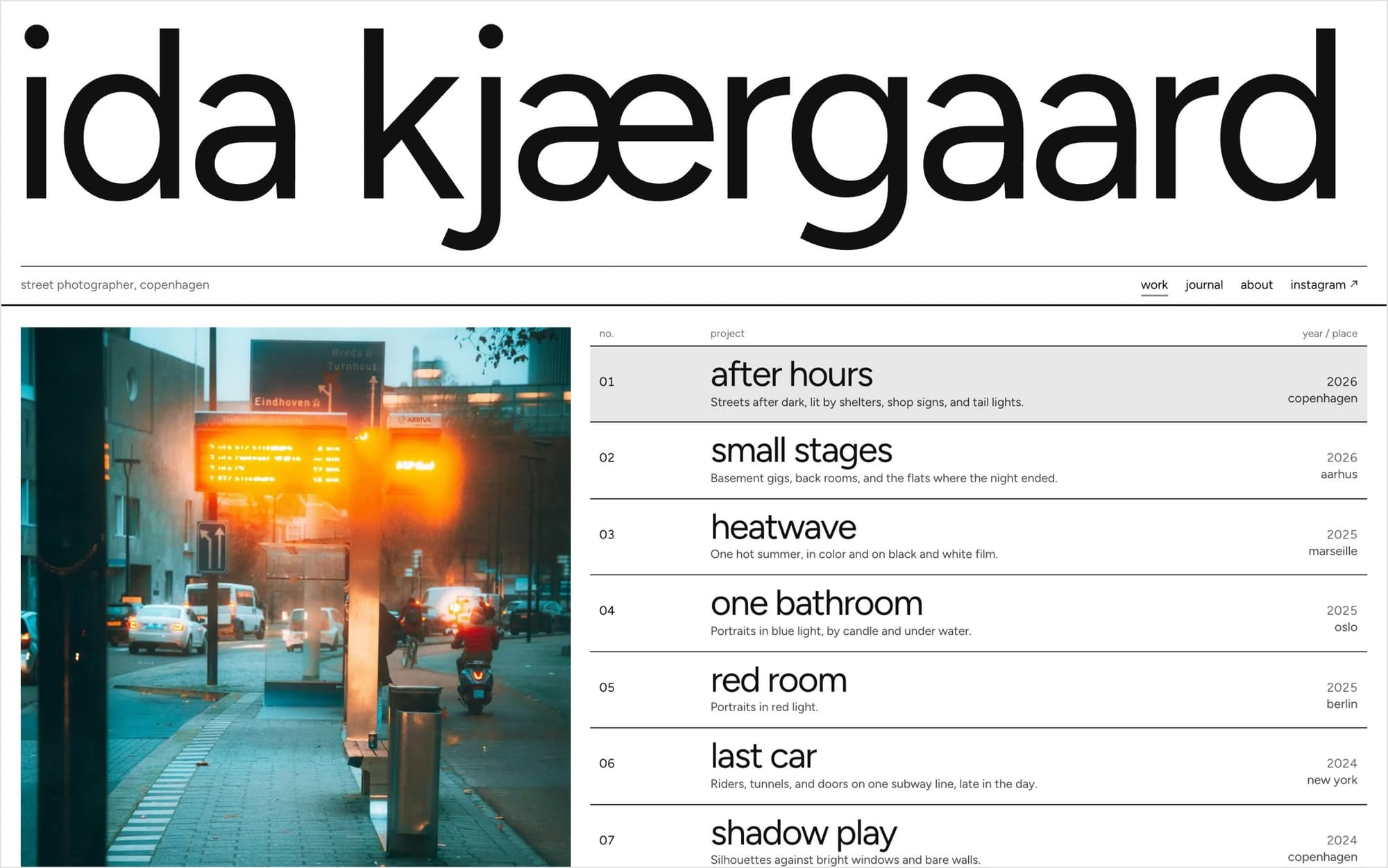
Yes, with the right theme. Out of the box, Ghost is made for writing. A portfolio theme turns your posts into project pages, gives your images room, and adds an about page that reads like a CV. Your newsletter and journal come along for free. That's why we build portfolio themes for it. See beautiful Ghost themes for portfolios, or our own, Index.
Headless Ghost: using Ghost as a headless CMS
Ghost can also run "headless": you write and manage members in Ghost, and a separate front end, built by a developer, fetches the content through Ghost's Content API. Most portfolios don't need this, since a theme does the same job without code, but it's why some developers choose Ghost.
What Ghost doesn't do
It's worth knowing the edges before you start:
- No built-in shop. You can sell prints or products by connecting Shopify, Gumroad, or a payment link, but there's no store inside Ghost.
- Fewer themes than the big builders. There are hundreds rather than thousands, and they're changed through settings, not a drag-and-drop page builder.
- No plugins. Ghost has integrations instead, like Zapier and webhooks, which cover most needs but not every one.
- Starter's theme limit. On Ghost(Pro), the Starter plan runs only Ghost's built-in theme. Installing any other theme needs Publisher.
For a portfolio, a journal, and a newsletter, none of these usually matter. For a large store or a booking-heavy business, they might.
How Ghost compares
- Ghost vs WordPress: Ghost is fast and simple to run, and WordPress is more flexible, with more plugins. Read the comparison.
- Ghost vs Squarespace: Ghost includes newsletters and lets you take everything with you. Read the comparison.
- Ghost vs Substack: Ghost gives you your own website and takes no cut of paid subscriptions. Read the comparison.
How to try it
Ghost runs a public Ghost CMS demo you can click around in, no sign-up needed. When you're ready to try it yourself, Ghost(Pro) has a free trial, so you can set up a site and see how it feels before you pay. If you're building a portfolio, follow how to make a portfolio website with Ghost. Once you've picked a theme, here's how installing a theme on Ghost works.
Turning Ghost into a portfolio
Ghost on its own is made for writing. We built Index to make it a home for visual work: posts become projects with their own photo layouts, the homepage becomes a numbered index of your work, and the about page becomes a CV. It's all set in Ghost's design settings, so you never touch code, and you keep everything Ghost already does, from newsletters to members.
Index is our portfolio theme for Ghost, if you'd like to see what a Ghost site for visual work can look like. Take the tour, or open the live demo and switch layouts as you browse.
Guides in this series
- How to make a Ghost website, step by step
- Ghost pricing: every Ghost(Pro) plan
- Self-hosted Ghost vs Ghost(Pro)
- Managed Ghost hosting on Synaps Media
- Ghost CMS SEO for portfolios
- The best Ghost themes, and free Ghost themes
Questions people ask
What is Ghost?
Ghost is an open-source platform for websites, blogs, and email newsletters. It includes members, paid subscriptions, search, and comments, and is run by the Ghost Foundation, a nonprofit.
Is Ghost CMS free?
The software is free and open source, so you can run it on your own server for the cost of the server. Ghost(Pro), the official hosting, starts at $15 a month billed yearly, or $29 for the plan that allows custom themes.
What is Ghost used for?
Blogs, newsletters, independent publications, and portfolios. Writers, journalists, photographers, designers, and small studios use it to publish work and reach readers by email.
Is Ghost better than WordPress?
For blogs, newsletters, and portfolios, we think so. Ghost is faster, simpler to run, and has newsletters built in. WordPress has more plugins, which matters for large shops or unusual features.
Who makes Ghost?
Ghost was started in 2013 by John O'Nolan and Hannah Wolfe and is run by the Ghost Foundation, a nonprofit. Its code is open source and developed in public.
Is Ghost a CMS?
Yes. Ghost is a content management system, or CMS, focused on publishing: websites, blogs, and newsletters. People often call it Ghost CMS to tell it apart from other things named Ghost.
Who uses Ghost CMS?
Independent publications, writers, and creators. Ghost's own homepage lists publications such as 404 Media, Platformer, Tangle, and The Lever, and many artists, photographers, and studios use it for portfolios.
Is Ghost a legit company?
Yes. Ghost is run by the Ghost Foundation, a nonprofit, and its software is open source under the MIT license. Ghost(Pro), its paid hosting, funds the work, and publications such as 404 Media and Platformer run on it.
Written by Pacha Themes. A small design studio making spacious, minimal themes for Ghost. Our first, Index, is a portfolio theme with 24 layouts, built and tested on Ghost 6. We write about Ghost, web design, and tips for creators here.